
What Is llms.txt and Does Your Website Need It Yet?



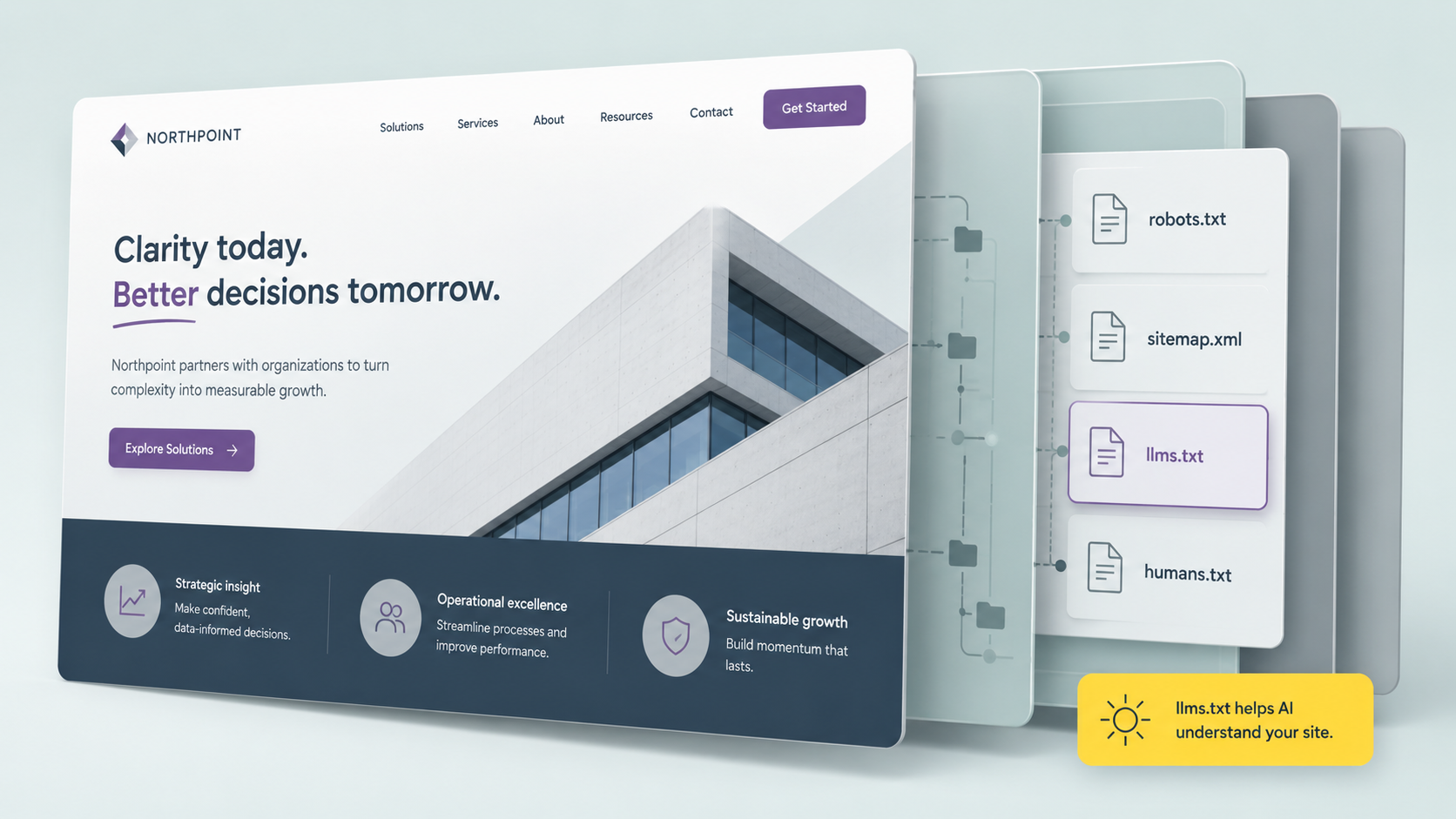
If llms.txt has landed on your radar lately, you’re not alone. Plenty of marketers, business owners and website managers are hearing that this new file is the next must-have for AI visibility. The pitch is usually dramatic: add llms.txt now or risk becoming invisible to AI.
That’s a little much.
We’ve been digging into the conversation at Market Mentors and here’s the straight answer: llms.txt is real, it may be useful in some cases and it is not something every website needs right now. [llms.txt proposal]
What is llms.txt?
llms.txt is a proposed text file that lives at the root of a website, usually at a URL like yoursite.com/llms.txt. It is written in a simple Markdown format and is meant to give large language models a cleaner overview of a site’s most important content. [llms.txt proposal]
A typical llms.txt file may include:
- A short summary of the business, product or website
- Links to priority pages, documentation or resources
- Light guidance on what content matters most
The goal is straightforward: give AI systems an easier starting point than a complex web page filled with navigation, scripts and design elements. That idea has appeal, especially for technical sites with product documentation, APIs and knowledge bases. [llms.txt proposal] [Anthropic on tools for agents]
What llms.txt is not
Here’s where the conversation often gets ahead of itself.
llms.txt is not an official web standard like robots.txt. It is a proposal that has gained attention in developer and documentation circles. It may help some AI-powered tools, especially in custom workflows, but there is not clear public evidence that mainstream consumer AI tools automatically check a brand’s llms.txt file whenever someone asks a general question. [llms.txt proposal] [OpenAI crawler docs] [Google AI optimization guide]
That distinction matters.
When people ask AI tools about a company, product or service, those systems may rely on training data, web search, connected tools, indexed pages or other retrieval methods depending on the product and the prompt. OpenAI’s public documentation for ChatGPT search and crawlers centers on search features and web crawling, and Google’s guidance for AI search features focuses on standard search best practices rather than special AI-only files. [OpenAI crawler docs] [Google AI features and your website] [Google AI optimization guide]
Where llms.txt may help
This does not make llms.txt useless. It just makes it situational.
A thoughtfully written llms.txt file may be worth exploring if your organization has:
- Developer documentation
- API references
- Technical product guides
- A large help center or knowledge base
- Custom AI agents or retrieval-augmented generation workflows
In those environments, a clean map of priority content can be genuinely helpful. It may improve how an agent or coding assistant finds the right documentation, especially when a developer intentionally includes that file in a workflow. [llms.txt proposal] [Anthropic on tools for agents] [Anthropic on building effective agents]
For a typical marketing website, though, the payoff is much less clear. Google now explicitly says site owners do not need llms.txt files or other special AI text files to appear in generative AI search experiences. [Google AI optimization guide]
Why we’re taking a measured approach
At Market Mentors, we like useful innovation. We’re just not in the business of stapling hype to every client deliverable.
Adding llms.txt the right way takes more than dropping a file onto a server. It needs thoughtful structure, accurate links, current messaging and regular upkeep. For most brand and service websites, that effort is better spent on the fundamentals that already support both traditional search and AI-assisted discovery. Google’s guidance for AI features says success generally comes from the same foundational practices that matter in Search overall. [Google AI features and your website] [Google AI optimization guide]
That means:
- Clear site architecture
- Strong page titles and meta descriptions
- Helpful original content
- Schema markup where appropriate
- Fast load times
- Accurate business information
- Pages that answer real user questions plainly and well
Those are still the heavy hitters. Google specifically recommends focusing on useful people-first content and says structured data can help search engines better understand pages and enable richer search appearances. [Google AI features and your website] [Google structured data intro]
If your site already struggles with thin content, messy navigation or outdated copy, llms.txt is not the fix. It is an extra layer, not a rescue plan. [Google AI optimization guide]
Our view on llms.txt for marketing sites
Right now, we do not see llms.txt as a blanket requirement for every website.
We do see it as a maybe for the right kind of site.
If your business depends on technical accuracy and AI tools frequently need to interpret your documentation, it may be worth testing. If your site is primarily there to explain services, build credibility and generate leads, the smarter move is usually to focus on content quality, structured data and technical SEO first. [Anthropic on tools for agents] [Google AI optimization guide] [Google structured data intro]
No panic. No magical thinking. No shiny-object detour.
What should businesses do now?
Here’s the practical takeaway:
- Do not assume your brand is invisible to AI without llms.txt
- Prioritize content clarity, crawlability and structured data first
- Consider llms.txt only if your site has substantial technical documentation or AI-specific retrieval needs
- Keep an eye on adoption, because this space is still changing
AI discovery is evolving fast, but the core play has not changed much: publish useful content, organize it well and make it easy for both people and machines to understand. That strategy still pulls its weight. [OpenAI crawler docs] [Google AI features and your website] [Google AI optimization guide]
The Market Mentors Team is helping brands grow smarter in the AI era. Get in touch with us to find out what we can do for you.
Share this post
Blog
Related posts
Like your own, our industry never stands still. Explore hot topics, tips, tactics and more.

The GEO mandate: what KPMG’s warning means for your content
Being on page one matters less than being the source AI trusts enough to quote. Here's what KPMG's…

7 Reasons Why Web Development Is Important for Small Businesses
Discover how web development boosts small business growth. Learn the key benefits that can enhance your online presence…

Why Specifications Should Not Be Buried Treasure
Discover how clear specifications enhance visibility and drive sales. Learn to structure content for both technical buyers and…